



Recent News
- ▶ Flat wall-mounted wind-sand separator
- ▶ Air Cooled Condensing Unit | ACCU HVAC Refrigeration Unit
- ▶ Xinran NG Compressor System Passes FAW Jiefang Validation
- ▶ China's High-Power Diesel Generators Export Surge 131.81%
- ▶ High-Efficiency Industrial Centrifugal Fans Low-Noise Air Blower for Boiler Induced Draft Fans
- ▶ Explosion-Proof Ffrp Roof Exhaust Fan - FRP Material, High Efficiency for Industrial Use
Message
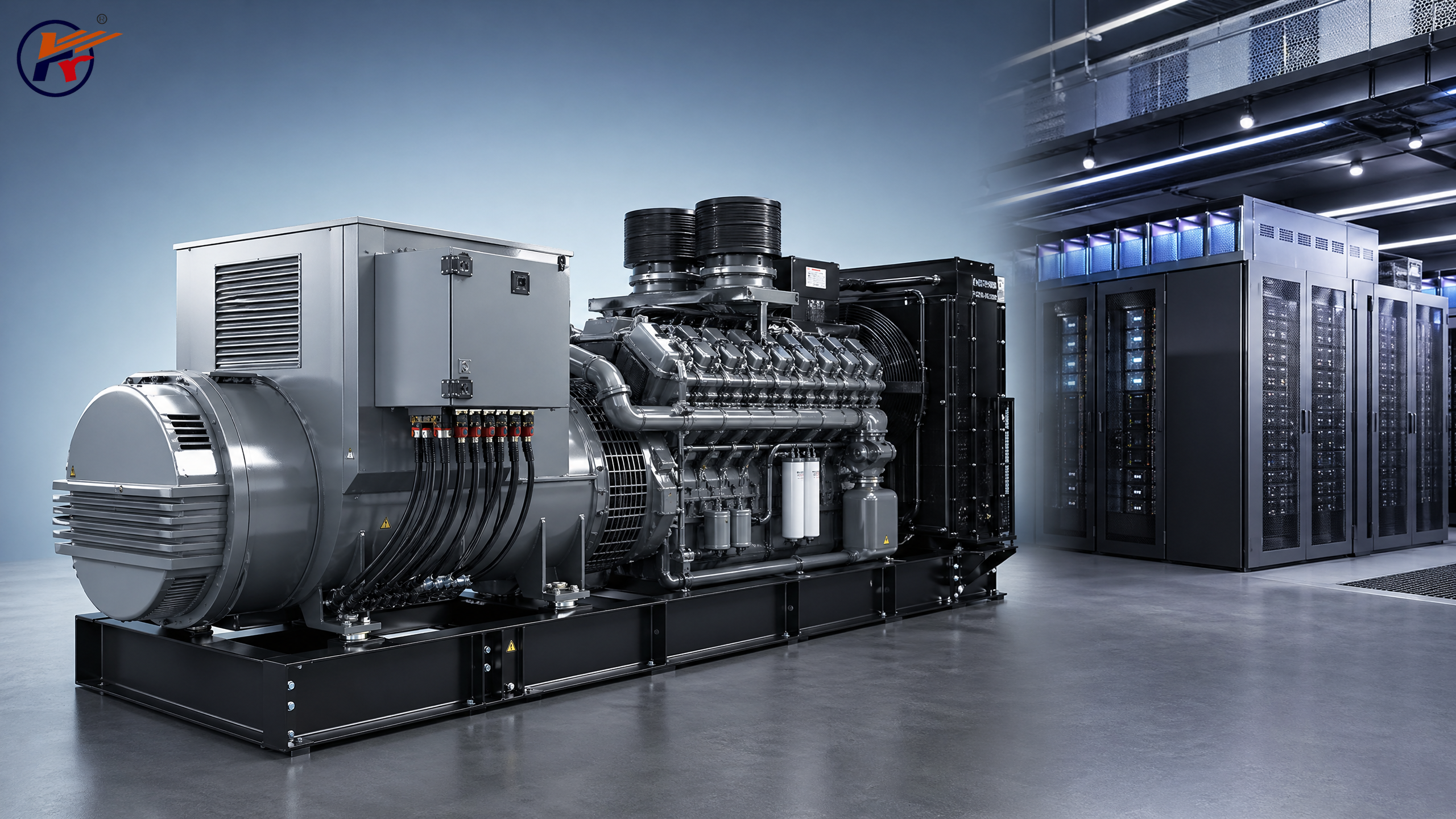
China’s high-power diesel generator sets—particularly 4.2 MW units destined for data centers—saw export value jump 131.81% year-on-year in January–February 2026, driven by global AI compute infrastructure expansion. This trend signals material implications for power equipment exporters, supply chain actors, and energy resilience planners in data-intensive industries.
Event Overview
In January–February 2026, China’s exports of high-power diesel generator sets reached RMB 1.2901 billion, up 49.66% year-on-year. Exports of 4.2 MW-class units—specifically designated for data center applications—rose 131.81% in value. Germany’s order volume doubled (+100% YoY), while the EU and South Korea markets registered new commercial breakthroughs. All figures reflect official export valuation data for the stated period.
Industries Affected
Direct Exporters (OEM/ODM Power Equipment Manufacturers)
These firms face immediate demand shifts toward higher-power, data-center-grade configurations. The surge reflects not just volume growth but a structural pivot toward reliability-critical, grid-adjacent backup power systems—requiring tighter thermal management, faster start-up response, and compliance with Tier IV-equivalent uptime expectations.
Supply Chain Component Suppliers
Suppliers of heavy-duty alternators, industrial-grade engine control units (ECUs), and emission-compliant turbocharged diesel engines may see revised order profiles. Demand is increasingly weighted toward modules certified to EU Stage V or Korea’s K-EMI standards—not just general industrial specs.
Data Center Infrastructure Providers (Non-Equipment)
Facility designers, commissioning engineers, and uptime consultants must now account for tighter integration requirements between generators and uninterruptible power supply (UPS) systems. The 4.2 MW unit’s adoption implies larger single-point backup capacity, affecting redundancy architecture and fuel logistics planning.
International Certification & Compliance Services
Third-party testing labs and certification bodies supporting CE marking, KC mark, and EN 60034/EN 61000 series standards are likely to see increased workload—especially for transient load-response validation and harmonic distortion testing under variable AI workload profiles.
What Enterprises and Practitioners Should Monitor and Act On
Track regulatory alignment timelines—not just market entry
EU and South Korean procurement for critical infrastructure increasingly references EN 50171:2022 (centralized emergency power systems) and Korea’s KNX-based interoperability mandates. Exporters should verify whether current certifications cover these specific clauses—not only broader safety or emissions standards.
Prioritize technical documentation localization for target markets
German and Korean tenders now routinely require full operating manuals, maintenance schematics, and fault-code diagnostics in local language—and often mandate on-site service technician certification. Pre-translating and validating documentation ahead of tender cycles reduces qualification delays.
Assess fuel logistics compatibility early in project scoping
4.2 MW units operating at partial load for extended periods (e.g., during AI training job bursts) exhibit different fuel consumption and sludge accumulation patterns than traditional telecom or industrial gensets. Partners involved in site commissioning should jointly validate fuel tank sizing, filtration specs, and cold-weather additive requirements against local climate and usage profiles.
Monitor downstream inventory signals—not just headline export data
A 131.81% YoY increase in 4.2 MW unit exports reflects front-loaded orders; however, lead times for key components (e.g., high-speed permanent magnet alternators) remain extended. Firms should cross-check port-level shipment manifests and customs partner data—not just national aggregate statistics—to gauge actual throughput velocity.
Editorial Perspective / Industry Observation
Observably, this export surge is less an isolated trade statistic and more a leading indicator of infrastructure layer realignment: AI compute growth is no longer abstract—it is physically demanding higher-capacity, higher-reliability, and jurisdictionally compliant backup power assets. Analysis shows that the 131.81% figure reflects concentrated demand from hyperscale edge sites and sovereign cloud facilities—not broad-based industrial replacement. From an industry perspective, this signals a narrowing window for technical catch-up: product differentiation now hinges less on cost and more on certified performance under dynamic load conditions and recognized regional conformity pathways. It is currently better understood as a signal—confirming directional investment priorities—rather than a fully matured market outcome, given that most EU/Korean deployments remain in pilot or Phase 1 commissioning stages.
This development underscores how AI-driven infrastructure scaling is reshaping long-established power equipment supply chains—not merely expanding them. For stakeholders, it reinforces the need to treat export growth not as volume opportunity alone, but as a catalyst for deeper technical, regulatory, and logistical alignment across geographies. The current data point is best interpreted as validation of a structural shift already underway in global compute infrastructure planning—not as a short-term spike requiring reactive scaling.
Information Source: Official Chinese customs export valuation data (January–February 2026), categorized by HS Code 8502.11 (diesel generating sets >1 MW) and application annotation (data center use). Note: Market-specific order volumes (e.g., Germany +100%) derive from aggregated tender award disclosures and importer declarations—subject to ongoing verification through Q2 2026 customs sub-category reporting.
Leave A Message
If you are interested in our products and want to know more details, please leave a message here, we will reply you as soon as we can.