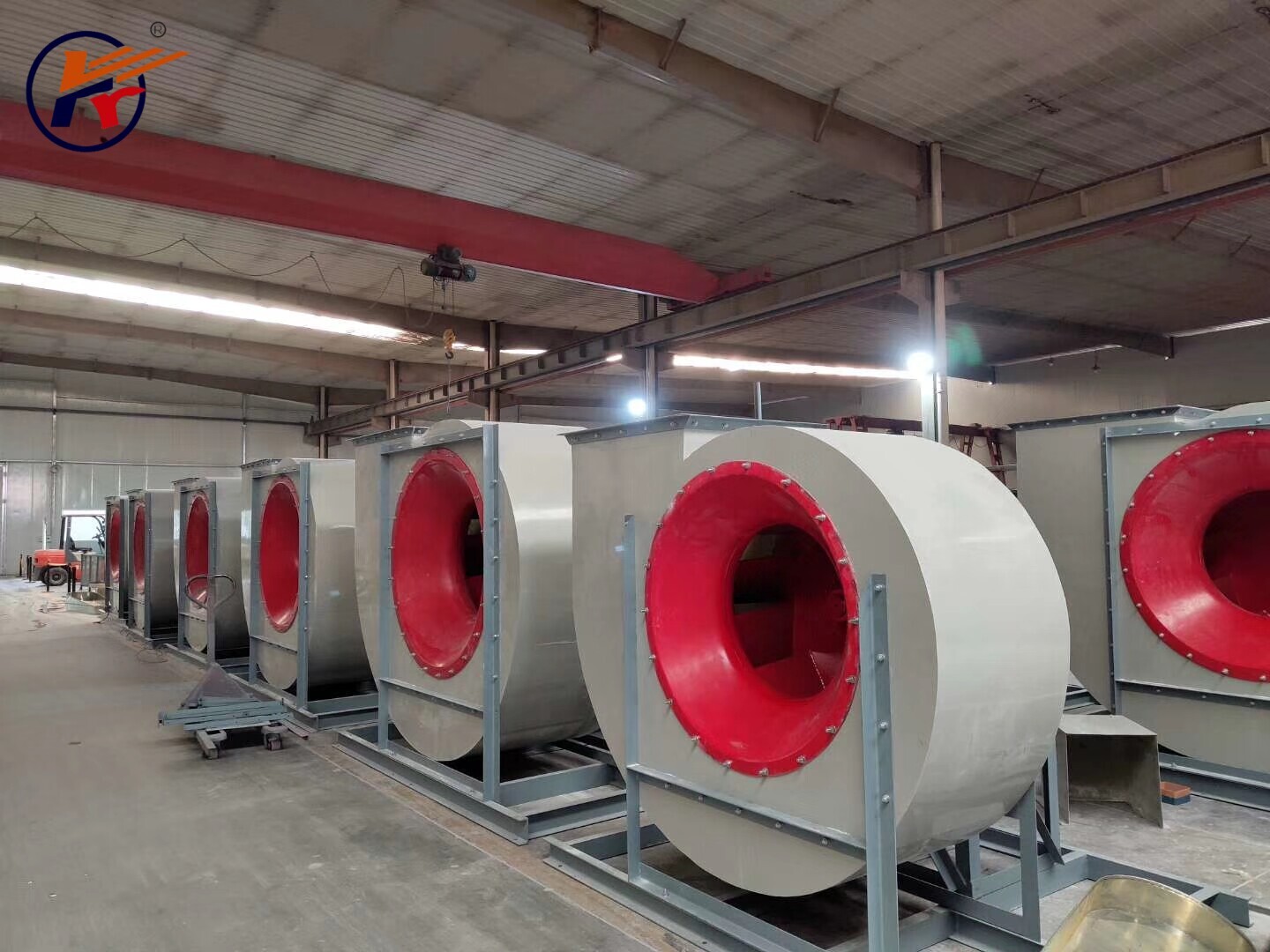
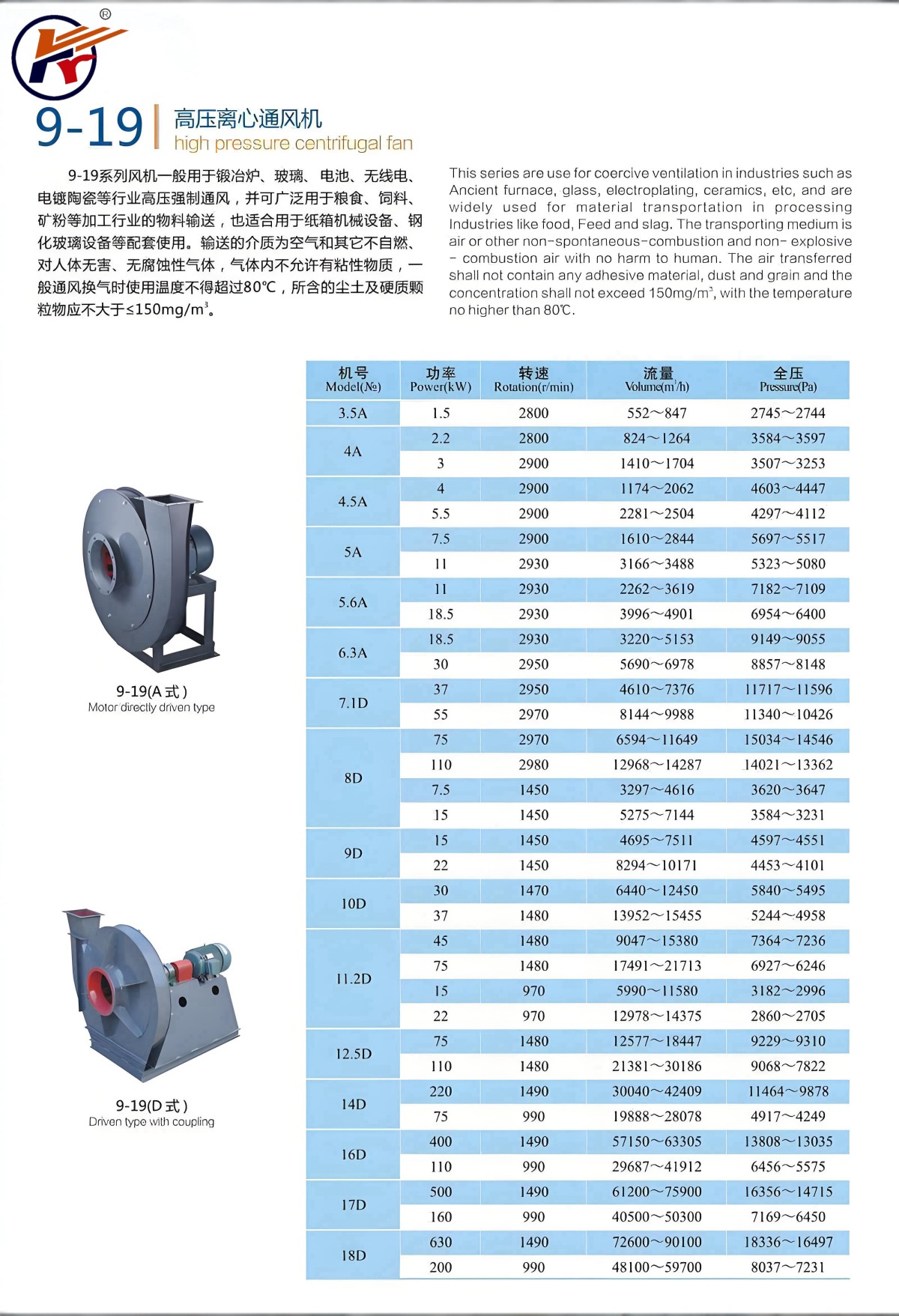
In various industrial production scenarios, the high-pressure centrifugal fan is an indispensable key power equipment. Relying on its strong air pressure boosting and conveying capabilities, it provides stable support for various process links that require high-pressure air flow. As an important branch of centrifugal fans, the high-pressure centrifugal fan is generally defined by a core criterion of outlet pressure exceeding 30kPa (gauge pressure). Different from medium and low-pressure centrifugal fans, it has unique advantages in structural design, performance parameters, and application scenarios, and is widely used in key national economic industries such as electric power, chemical engineering, metallurgy, and environmental protection.
From the perspective of core structure, a high-pressure centrifugal fan is mainly composed of components including an impeller, a casing, an air inlet, an air outlet, a transmission assembly, and a motor. The precise coordination of these components is the foundation for realizing high-pressure air supply. As the core power-generating component, the impeller mostly adopts a backward-inclined plate or airfoil blade design, with the number of blades usually ranging from 10 to 20. The material can be carbon steel, stainless steel, or fiberglass reinforced plastic (FRP) according to operating conditions. This not only ensures high strength to withstand the impact of high-pressure air flow but also reduces eddy current losses of air flow inside the impeller. The casing adopts a volute structure, and its inner wall is optimized with a streamlined design, which can guide the air flow to gradually expand and pressurize along the casing wall, efficiently converting the kinetic energy transmitted by the impeller into pressure energy while reducing air flow noise. The transmission assembly mostly uses a coupling or belt drive: coupling drive is suitable for high-speed, high-power models and can reduce transmission losses, while belt drive facilitates adjusting the fan speed to meet air volume regulation requirements under different operating conditions.
The working principle of the high-pressure centrifugal fan is based on the centrifugal force work mechanism in fluid mechanics. When the motor drives the impeller to rotate at high speed, the gas inside the impeller is thrown to the edge of the impeller under the action of centrifugal force. At this time, a negative pressure zone is formed at the center of the impeller, and external gas is continuously sucked into the impeller through the air inlet under atmospheric pressure. During the rotation of the impeller, the gas entering the impeller not only gains kinetic energy from circular motion but also accelerates gradually under the pushing action of the impeller blades. It then enters the volute casing, where the diffuser channel inside the casing gradually reduces the air flow speed. According to Bernoulli's principle, the kinetic energy of the air flow is converted into static pressure energy, and finally, the air is discharged from the air outlet in a high-pressure state, completing the entire air flow conveying cycle of "suction - pressurization - exhaust". Compared with axial flow fans, the air flow direction of the high-pressure centrifugal fan is perpendicular to the motor axis, and the air flow diffuses more fully inside the casing. Therefore, it can achieve higher outlet pressure and meet the air flow conveying needs of long-distance and high-resistance pipelines.
In terms of performance characteristics, the high-pressure centrifugal fan has three core advantages: First, it has a wide pressure range. Its outlet pressure can range from 30kPa to over 150kPa, and some special models can even reach 300kPa, which can adapt to different pressure demand scenarios, from industrial dust removal pipeline pressurization to high-pressure pneumatic conveying. Second, it has strong operational stability. Due to the centrifugal working method, the air flow inside the fan is more stable. In addition, the impeller has high dynamic balance accuracy (usually reaching G2.5 class or above), so the fan has small vibration amplitude during operation, and the noise level can be controlled below 85 decibels (measured 1 meter away from the unit), enabling it to adapt to long-term continuous operation (annual operating time can reach more than 8,000 hours). Third, it has flexible adjustment performance. Equipped with a variable-frequency motor or an inlet guide vane, it can realize stepless adjustment of air volume, with an adjustment range usually between 30% and 100%. When the operating conditions change, the speed or air flow inlet angle can be adjusted to avoid energy waste caused by "a large horse pulling a small cart", achieving an energy-saving rate of 15% to 30%.
From the perspective of application scenarios, high-pressure centrifugal fans are widely used in multiple key industrial fields. In the electric power industry, they are used as induced draft fans and forced draft fans for boilers in thermal power plants. The induced draft fan needs to overcome the high resistance of the boiler flue to extract the flue gas generated by combustion and send it to the desulfurization and denitrification system, while the forced draft fan provides high-pressure combustion-supporting air for the boiler combustion chamber to ensure full combustion of fuel. In the chemical industry, they are often used in high-pressure pneumatic conveying systems to transport powdered materials such as coal powder and plastic particles to reaction kettles or storage tanks through pipelines. The conveying distance can reach hundreds of meters, and it can prevent the materials from getting damp or contaminated during transportation. In the environmental protection field, they are the core power equipment of bag filters. By providing high-pressure air flow, the dusty gas passes through the filter bag at a certain speed to separate dust from the gas. At the same time, they can overcome the resistance change caused by filter bag blockage to ensure the stable operation of the dust removal system. In addition, high-pressure centrifugal fans also play an irreplaceable role in scenarios such as blast furnace air supply in the metallurgical industry and cement kiln tail ventilation in the building materials industry.
It is worth noting that the selection and maintenance of high-pressure centrifugal fans are crucial to their performance. During selection, factors such as the pressure demand of the operating conditions, air volume parameters, and the characteristics of the conveyed medium (such as dust content, corrosiveness, and temperature) must be comprehensively considered. For example, when conveying high-temperature flue gas, a high-temperature-resistant impeller material should be selected; when conveying corrosive gas, the casing should be treated with an anti-corrosion coating. In daily maintenance, it is necessary to regularly check the wear of the impeller (especially when conveying dusty gas), the lubrication status of the bearings, and the operating temperature of the motor to avoid a decrease in fan efficiency or even shutdown due to component aging or failure. With the increasing demand for energy conservation and intelligence in the industrial field, today's high-pressure centrifugal fans are developing towards high efficiency (total pressure efficiency can reach more than 90%), large scale (air volume of a single unit can reach 100,000 m³/h), and intelligence (equipped with remote monitoring and fault diagnosis systems), providing more powerful power support for the green transformation and efficient operation of industrial production.
Centrifugal Fan(风机系列).pdf