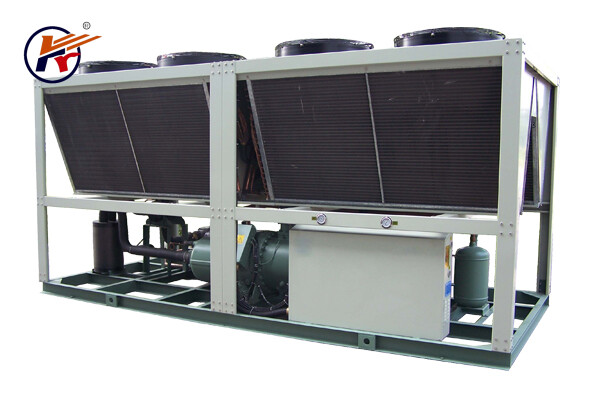
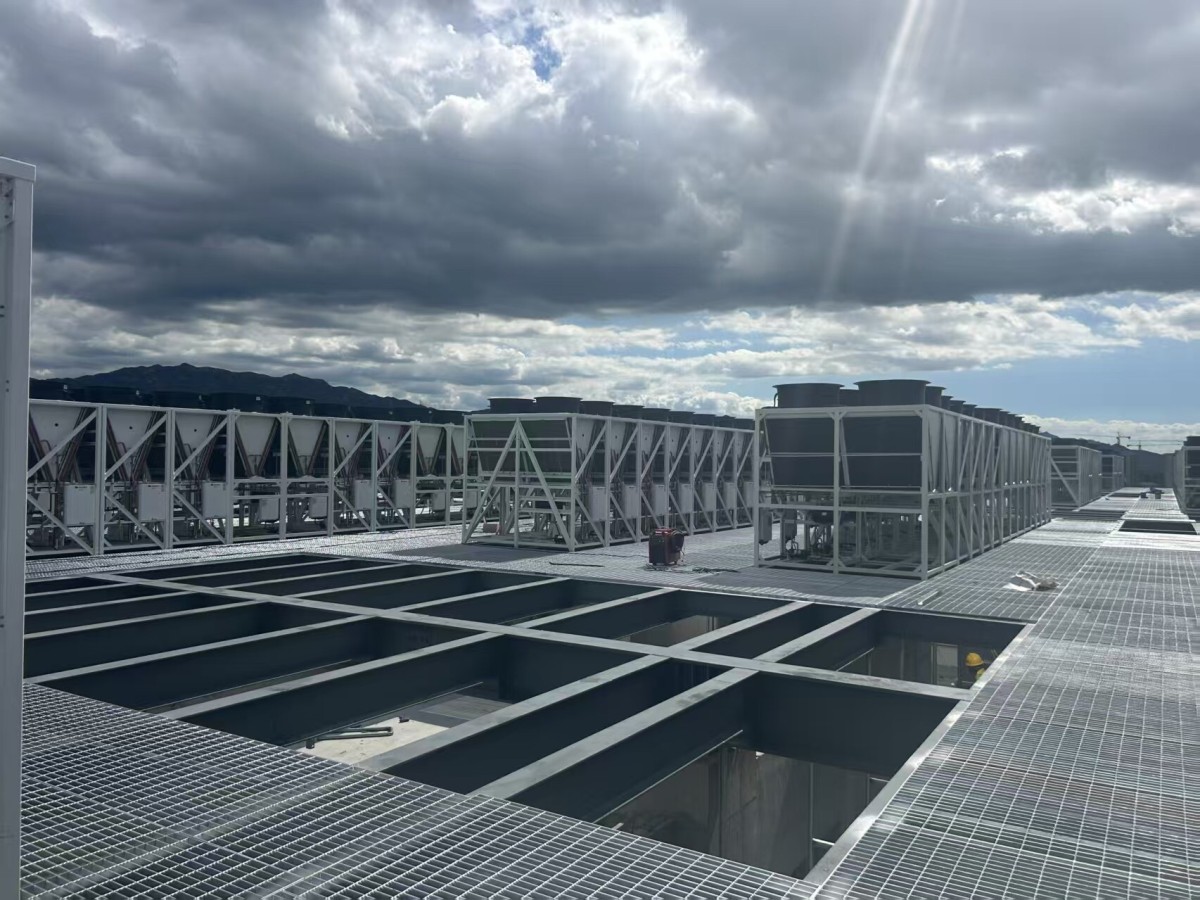
A chiller is the refrigeration source and "heart" of a central air - conditioning system. In the refrigeration industry, it is mainly divided into two types: air - cooled chillers and water - cooled chillers. Compressors are mainly used in screw chillers, scroll chillers, and centrifugal chillers (piston - type ones are relatively rare now). According to the temperature, chillers can also be classified into low - temperature industrial chillers and normal - temperature chillers.
A chiller is a type of vapor - compression refrigeration unit. Its refrigeration principle is as follows: the compressor applies energy to the refrigerant vapor to increase its pressure and temperature. Then, through the processes of condensation and throttling, the refrigerant becomes a low - pressure and low - temperature liquid. This liquid refrigerant evaporates into vapor in the evaporator and absorbs heat from the surrounding environment (a coolant, such as chilled water) at the same time, lowering the temperature of the coolant. In this way, the purpose of artificial refrigeration is achieved. It can be seen that the vapor - compression refrigeration cycle consists of four essential processes: compression, condensation, throttling, and evaporation.
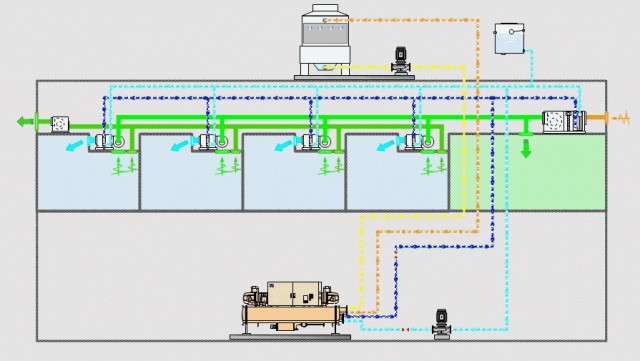
The heat exchange system of a chiller is composed of two circulating water systems:
- The chilled water circulation system
- The cooling water circulation system
This system is made up of chilled water pumps and chilled water pipelines. The chilled water flowing out of the chiller is pressurized by the chilled water pumps and sent into the chilled water pipelines. It conducts heat exchange in each room, absorbing the heat inside the rooms and thus lowering the temperature of the rooms.
This system consists of cooling water pumps, cooling water pipelines, and cooling towers. When the chiller conducts heat exchange to cool the water temperature, it will definitely release a large amount of heat. This heat is absorbed by the cooling water, causing the temperature of the cooling water to rise. The cooling water pumps press the heated cooling water into the cooling towers, where the cooling water exchanges heat with the atmosphere. After that, the cooled cooling water is sent back to the chiller. This cycle continues to remove the heat released by the chiller.
The common design temperature difference of chillers is 5℃. During operation, if the temperature difference between the inlet and outlet water of the unit is less than 5℃, it is usually because the water pump flow is greater than the designed flow of the unit. If the temperature difference between the inlet and outlet water is too large, the causes may include abnormal water pump operation, small valve opening, insufficient water in the system, insufficient water in the cooling tower, or blockage of the unit's water filter. Operators should check in a timely manner and clean the water filter regularly.
The set outlet water temperature of the unit ranges from 7℃ to 12℃, and the inlet water temperature ranges from 12℃ to 17℃. During operation, if the water temperature is too low for a long time, it will pose a risk to the unit. At this time, operators should check the unit settings and water flow to avoid damaging the unit. If the water temperature is too high during operation, check the unit settings (e.g., high set temperature), the impact of high cooling water temperature on refrigeration, or whether the heat load exceeds the unit's refrigeration capacity due to high ambient temperature.
The outlet water temperature of the unit's cooling water ranges from 32℃ to 37℃, and the inlet water temperature ranges from 27℃ to 32℃. If the temperature is too low, it will reduce the refrigerant pressure difference of the unit and affect refrigeration. At this time, adjust by turning off the cooling tower fans and reducing the water flow. If the temperature is too high, it will trigger a high - pressure alarm or the unit will automatically reduce the load, affecting the refrigeration capacity. For centrifugal chillers, it may also cause surge and prevent normal operation. The causes include insufficient cooling capacity of the cooling tower, blockage of the cooling tower, insufficient water in the cooling tower, water pump failure, cooling tower fan failure, or filter blockage. Operators should check in a timely manner and clean regularly.
This temperature difference refers to the absolute value of the outlet water temperature minus the saturation temperature. By this temperature difference, operators can not only judge whether the evaporator/condenser is working normally but also determine if there is blockage in the water system. Usually, this value is lower than 2.5℃. If it is higher than this value, check for issues such as copper tube corrosion and leakage, scaling on the heat exchange tubes, non - condensable gases, or refrigerant leakage.
The discharge superheat is equal to the discharge temperature minus the condensation saturation temperature. This value reflects the working state of the compressor. For centrifugal chillers (using R134a refrigerant; the value varies with different refrigerants), this value is usually around 7℃, and its reasonable range is 4 - 10℃.
This value reflects the power consumption of the compressor. The more energy - efficient the compressor is, the lower the superheat will be; the higher the power consumption, the higher the superheat will be. It is worth noting that if this value is too low, it is abnormal, and the compressor may be caused by liquid carry - over in the suction. If this value is significantly high (e.g., 15℃), it indicates that the operating efficiency of the compressor is low. Possible causes include impeller failure, compressor reverse rotation, bearing wear, too low opening of the inlet guide vane, or significant deviation of the working condition from the designed condition.
If the condensing pressure of the unit is too high during operation, it will trigger a high - pressure alarm or the unit will automatically reduce the load, affecting the refrigeration capacity. For centrifugal chillers, it may also cause surge and prevent normal operation. Long - term operation under relatively high pressure will also affect the components and seals of the unit. The causes include insufficient cooling capacity of the cooling tower, blockage of the cooling tower, insufficient water in the cooling tower, water pump failure, cooling tower fan failure, filter blockage, scaling of the heat exchanger, or non - condensable gases entering the centrifugal chiller. Operators should check and handle in a timely manner.
The operating voltage of the unit should be between 342V and 418V, and the three - phase voltage should be balanced. Operators should check and record in a timely manner. The operating current of the unit should be within the set range, and the three - phase current should be balanced. Operators should check and record in a timely manner.
The oil level of the unit's lubricating oil should be within the range of the oil sight glass. Too low an oil level will affect the unit's operation and damage the unit.