



Recent News
- ▶ Flat wall-mounted wind-sand separator
- ▶ Air Cooled Condensing Unit | ACCU HVAC Refrigeration Unit
- ▶ Xinran NG Compressor System Passes FAW Jiefang Validation
- ▶ China's High-Power Diesel Generators Export Surge 131.81%
- ▶ High-Efficiency Industrial Centrifugal Fans Low-Noise Air Blower for Boiler Induced Draft Fans
- ▶ Explosion-Proof Ffrp Roof Exhaust Fan - FRP Material, High Efficiency for Industrial Use
Message
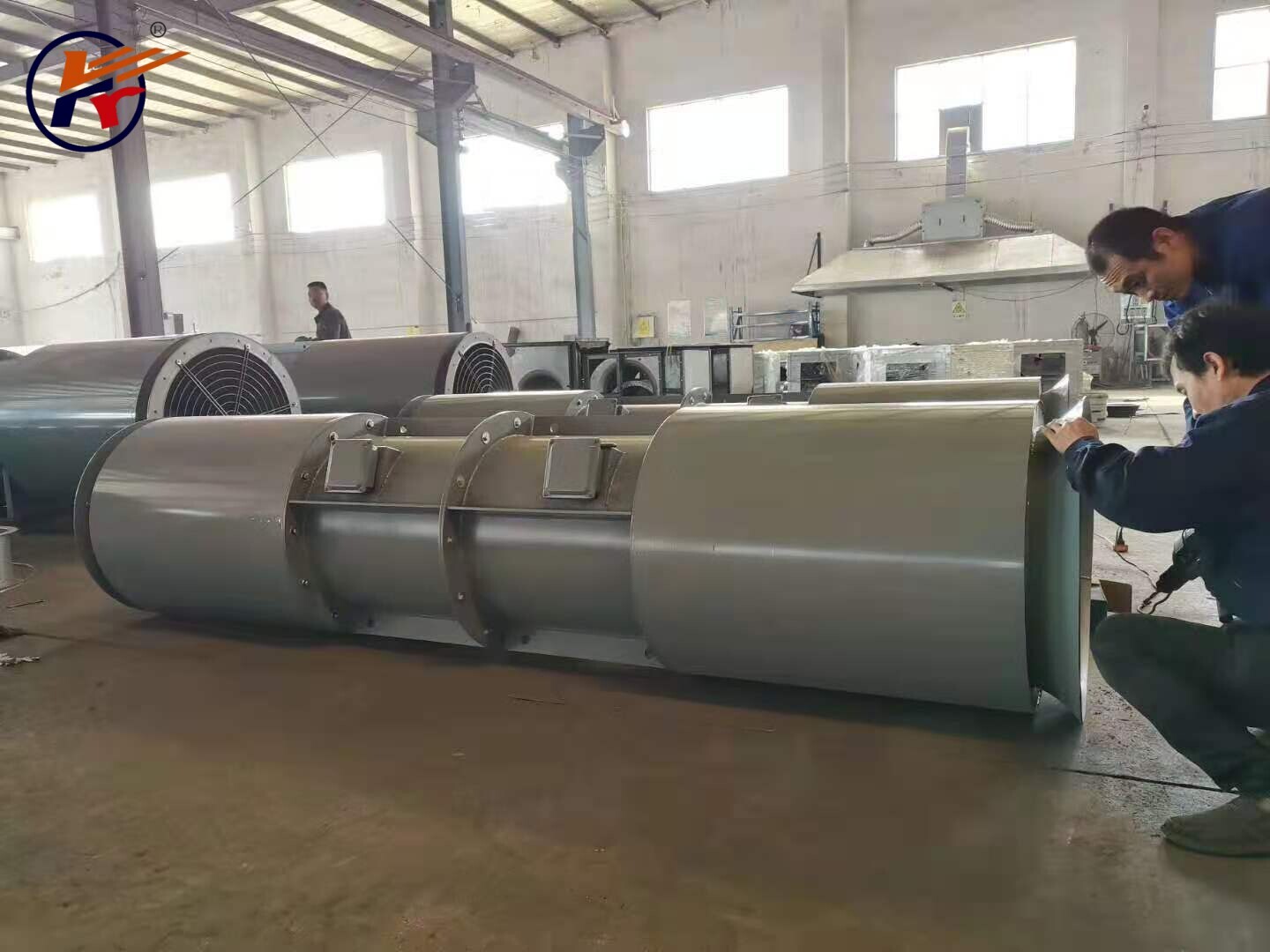
Working Principle & Technical Specifications
The tunnel jet fan operates by generating a high-velocity air stream (outlet velocity: 19.1-42 m/s), which propels the tunnel air along its axis to create a longitudinal ventilation flow. Its core feature is a counter-rotating dual-motor system, utilizing two-stage impellers to accelerate gas expulsion. Key performance parameters include:
Performance Range:
Air Volume: 56 - 1355 m³/min (covers ventilation needs from short tunnels to distances up to 2000m).
Total Pressure: 172 - 8600 Pa (adapts to various ventilation resistance scenarios).
High-Temperature Resistance: Capable of continuous operation for 2 hours in 280°C environments (a critical index for fire smoke extraction).
Technical Features:
Bi-Directional Operation: Electronic/mechanical forward-reverse switching within 30 seconds, with reverse airflow ≥ 98% of forward flow.
Noise Reduction: Double-layer silencer structure (1D/2D impeller diameter), ensuring noise level ≤ 77 dB(A) at 10 meters.
Construction: Aluminum alloy impeller with hot-dip galvanized casing, featuring corrosion resistance rating of IP55.
Application Scenarios
Core Functions:
Daily Ventilation: Removes exhaust fumes (CO, NOx) and dust from internal combustion engines, maintaining air quality.
Emergency Smoke Extraction: Rapidly switches to smoke exhaust mode during fires, achieving 4 complete air changes within 15 minutes.
Engineering Adaptability:
Mounting: Suspended installation on the tunnel ceiling or sides, requiring no traffic space and saving ductwork costs.
Ideal Applications: Railway tunnels (mandatory mechanical ventilation for lengths ≥ 2km), subways, and highway tunnels.
Leave A Message
If you are interested in our products and want to know more details, please leave a message here, we will reply you as soon as we can.