



Get Free Samples
Recent News
- ▶ Flat wall-mounted wind-sand separator
- ▶ Air Cooled Condensing Unit | ACCU HVAC Refrigeration Unit
- ▶ Xinran NG Compressor System Passes FAW Jiefang Validation
- ▶ China's High-Power Diesel Generators Export Surge 131.81%
- ▶ High-Efficiency Industrial Centrifugal Fans Low-Noise Air Blower for Boiler Induced Draft Fans
- ▶ Explosion-Proof Ffrp Roof Exhaust Fan - FRP Material, High Efficiency for Industrial Use
Message
Rooftop Air Conditioning Unit (RTU) Heat Pump: 2-in-1 Cooling & Heating, 30% Energy Savings for Commercial Buildings
Time : Nov 20, 2025
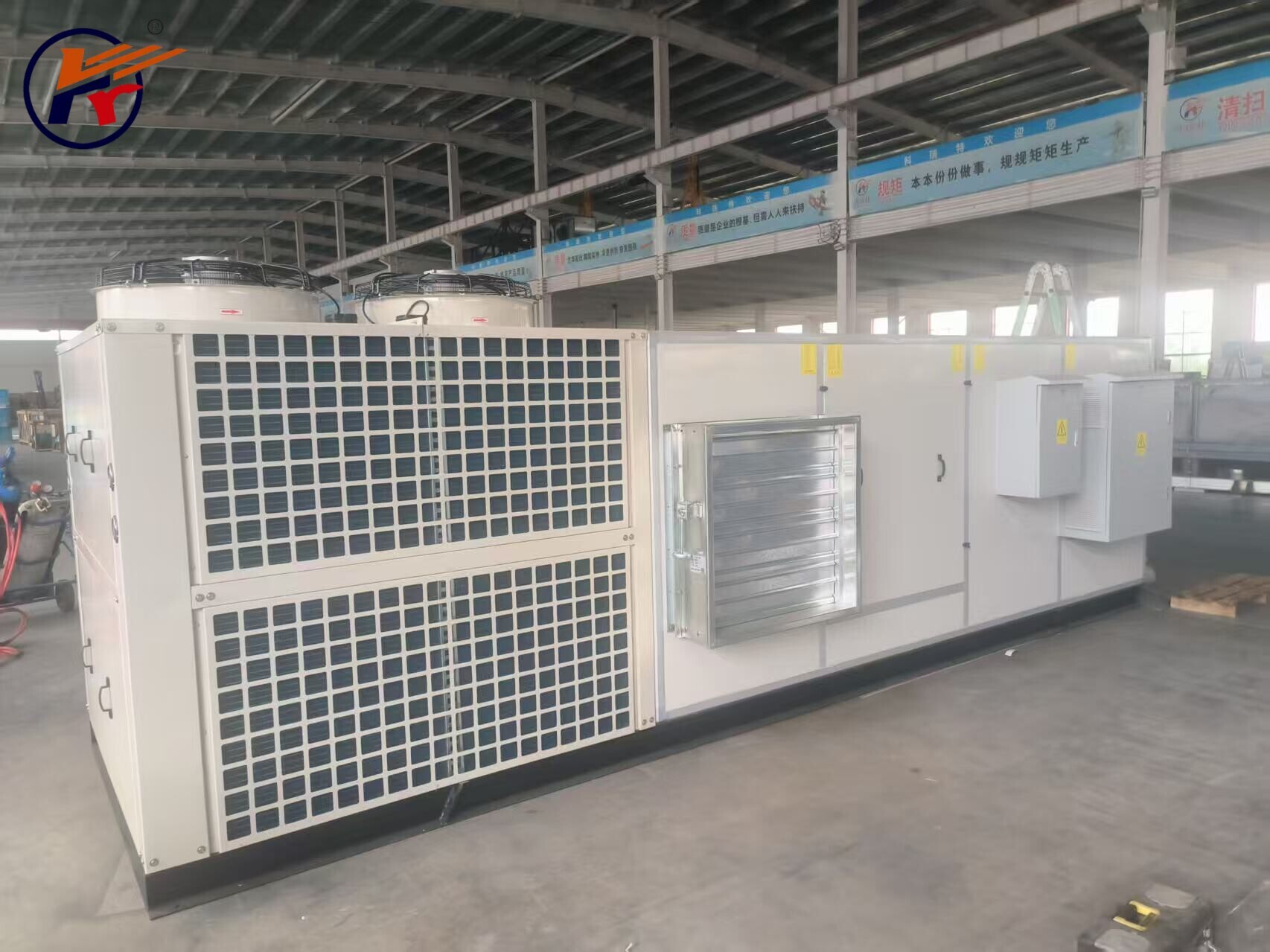
A rooftop air conditioning unit (RTU) is a large-to-medium-sized integrated air conditioning equipment with a built-in cold source and air cooling system. Its refrigeration, heating, humidification, air supply, air purification, and electrical control components are all integrated into a horizontal cabinet. It is named "rooftop air conditioning unit" because it is mostly installed on rooftops.
The rooftop air conditioning unit is a large-to-medium-sized integrated unit, composed of three sections: the compression-condensation section, the evaporation-filtration section, and the air supply section. By function, it can be classified into types such as cooling-only, electric heating, constant temperature and humidity, constant temperature and humidity cleanroom, and heat pump.
The heating methods of the rooftop air conditioning unit include heat pump heating, electric heating, steam heating, hot water heating, gas heating, etc.; humidification methods include electrode humidification, dry steam humidification, electric heating humidification, high-pressure micro-mist humidification, wet film humidification, etc. The unit can be equipped with additional functional sections such as a flow equalization section, medium-efficiency filtration section, noise reduction section, and air outlet section. Generally, conventional units installed on rooftops adopt horizontal return air & horizontal supply air modes, including: side return air & end supply air, end return air & end supply air; other return air & supply air modes include side return air & bottom supply air, bottom return air & end supply air, etc.
Working Principle
Cooling Mode
The outdoor finned heat exchanger acts as a condenser, and the indoor finned heat exchanger acts as an evaporator. The high-temperature refrigerant gas discharged by the compressor is condensed into a liquid in the outdoor finned heat exchanger, then throttled and depressurized by the expansion valve to become a low-temperature gas-liquid mixture. This mixture then flows into the indoor finned heat exchanger, absorbs heat, evaporates, and returns to the compressor, completing a refrigeration cycle. Meanwhile, the return air (or fresh air) from the indoor space passes through the indoor finned heat exchanger (acting as an evaporator at this time) to be cooled down, and the treated cold air is then sent back to the indoor space by the indoor fan.
Heating Mode
The outdoor finned heat exchanger acts as an evaporator, and the indoor finned heat exchanger acts as a condenser. The high-temperature refrigerant gas discharged by the compressor is condensed into a liquid in the indoor finned heat exchanger, then throttled and depressurized by the expansion valve to become a low-temperature gas mixture. This mixture then flows into the outdoor finned heat exchanger, absorbs heat, evaporates, and returns to the compressor, completing a refrigeration cycle. Meanwhile, the return air (or fresh air) from the indoor space passes through the indoor finned heat exchanger (acting as a condenser at this time) to be heated up, and the treated hot air is then sent back to the indoor space by the indoor fan.
Unit Features
- Wide Application Range
This series of products includes varieties such as constant humidity, cooling & heating, and heat pump types. Constant temperature and humidity units can meet the needs of places with high temperature and humidity requirements; cooling & heating units are suitable for comfort-oriented places; heat pump units can realize dual functions (cooling and heating) with one unit, reducing heating operation costs.
- Investment Saving
The unit is installed on the rooftop or outdoor open space, eliminating the need for a machine room and saving effective space. It does not require supporting equipment such as water pumps, cooling towers, and fan coils, reducing initial investment.
- Easy Installation
The unit does not require on-site configuration of refrigerant pipes or cooling water pipes. It can be put into use after connecting the air duct and power supply, saving on-site construction time and costs.
- High Efficiency & Energy Saving
The unit adopts high-performance scroll or screw compressors, featuring high volumetric efficiency and energy efficiency ratio (EER). Screw compressors can easily achieve four-stage or stepless capacity adjustment, with high efficiency under partial load. Refrigeration components such as expansion valves, filters, and solenoid valves are all imported brands from the United States, Italy, etc. The unit also does not require secondary refrigerants, ensuring high system efficiency.
- Quiet Operation
Equipped with high-performance scroll or screw compressors, the unit operates stably. Since the unit is placed outdoors, only air ducts need to be configured indoors, resulting in low indoor noise.
- Unique Structure
The unit's top panel adopts a special structure to prevent water ingress; the door panel is filled with polyurethane foam to ensure thermal insulation performance; the electrical box has a sealed structure to ensure electrical safety; power connections are placed inside the electrical box, avoiding the risk of rooftop water leakage.
- Safe Operation
The unit is equipped with multiple protection functions, including high-pressure protection, low-pressure protection, overload protection, short-circuit protection, phase failure protection, overheating protection, and under-air-pressure protection, as well as interlock protection with fire dampers.
- Intelligent Control
The unit adopts advanced control instruments, which can be equipped with dual controllers (one installed on the outdoor unit and the other in the indoor control room) for convenient operation. The instruments are equipped with an RS485 interface to enable remote control.
- Easy Function Expansion
The unit is equipped with multiple functional sections, which can easily realize air cooling, dehumidification, heating, humidification, filtration, and fresh air ventilation functions.
Leave A Message
If you are interested in our products and want to know more details, please leave a message here, we will reply you as soon as we can.